
2nd December 2025
Recent years and months have shown us a growing momentum around trauma-informed practice as an approach that can help challenge long-standing structural inequalities and progress the urgent need for meaningful cultural change.
Over the past year, Dartington has been on a journey with London’s Violence Reduction Unit to better understand how policing, healthcare and local authority practice in the capital might become more trauma-informed. This project has held trauma-informed principles at its core and explored how trauma-informed practice has the potential to help build systems that centre equity, foster safety and trust, and create the conditions for recovery and transformation for all children and young people to thrive.
At Dartington Service Design Lab, we use research and design to drive systemic change with and for children and young people and are often reflecting on how successful systems change work requires a shift in mindset that invites collaboration across differences and provides opportunity for hope - even in systems where barriers between people, services and supports may seem impossible to overcome.
Our hope is that the foundational work we have been doing together with London’s VRU is just the beginning of a greater moment of change, one that we can look back on and recognise as a point that genuinely shifted things.
Reflections from our recent Trauma-Informed London event: what we heard in the room
Recently we celebrated the launch of the Trauma-Informed London website and resources. The event brought together practitioners and leaders from local authorities, healthcare, policing and the voluntary sectors under a shared ambition: to reimagine how services function in London and how Londoners experience, access and engage with those services every day. The insights shared in the room paint a picture of what it takes to embed trauma-informed practice meaningfully and at scale, with learning relevant for services and systems beyond the capital.
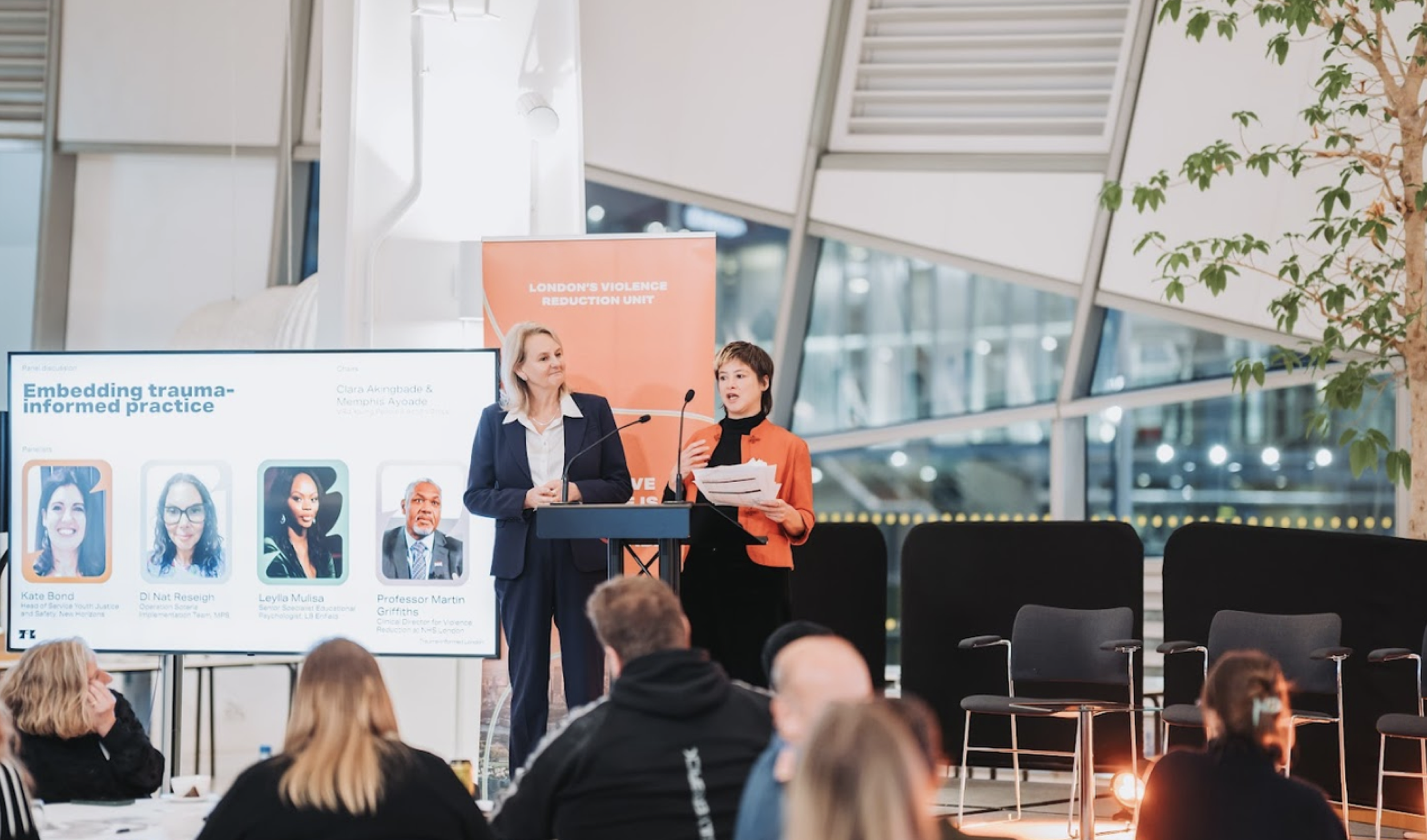
Dartington’s Katie Upsdale on stage introducing our research outputs
Trauma-informed practice is how we should all be working
Many attendees shared their everyday work that centres trauma-informed principles, such as building relationships slowly over time, taking care to listen and understand what lies behind people’s presenting behaviours, and having space to reflect and discuss practice with colleagues and in supervision. Trauma-informed practice is not new, but what Trauma-Informed London offers is a way of naming, strengthening and communicating what good practice looks like, even in services and settings such as the Met where cultures exist that are hostile to this way of working. First acknowledging that trauma-informed practice is a necessary part of all of our practice, and then finding ways to innovate and create space for it within our work is key.
Everyone has a role
Trauma-informed principles go beyond practice – they can (and should) underpin team cultures, leadership behaviours, commissioning approaches, partnership working, and how we design or re-design systems. Everyone has a part to play in making systems and services more trauma-informed.
It's not training – it’s reimagining what’s possible
Trauma-informed practice is not about achieving training milestones or tick box exercises that can be completed. Real trauma-informed work reshapes how we relate to one another, how power flows, and how organisations see people – not as cases or risks, but as individuals with context, history and potential.
Both a mindset and a method for change
During the panel section of the event, Dr. Leylla Mulisa and Prof. Martin Griffiths both shared how trauma-informed practice is both a mindset and a method. Holding onto the truth that systems are made up of people who are capable of individual action and change, our systems can be transformed through simple daily acts and shifts in thinking. For example, building empathy for colleagues who are stretched thin and unsupported, shifting responses from frustration and blame to understanding.

Panel members at Trauma-Informed London launch event
What next?
Already we can see the impact of the project, with colleagues in the Met using the learning to help leverage funding as it provides a basis for how working in a trauma-informed way drives good practice. The website and reports are a central resource for statutory services in London and beyond to use as a guide to collaboration, connection and organisational change.
We hope to see the impacts of this work in changes to commissioning language, developments in workforce support, the proliferation of reflective spaces and visible shifts in leadership behaviours. This movement will only start to be fully realised when services feel different to the people who use them. Therefore, the next steps for this work involve shifting culture, power dynamics, and rethinking how we work with and relate to one another – both within and across sectors.
At Dartington, we recognise the need to challenge old assumptions together and to continue to build shared language and strengthen relationships and collaboration for collective change. This is work and learning that has relevance beyond London. If you’re interested in connecting, sharing your journey around trauma-informed practice or exploring opportunities to collaborate, we would love to hear from you.
Photos from London’s Violence Reduction Unit.